




We may earn revenue from the products available on this page and participate in affiliate programs.Learn More ›
- Head size matters most, since a shorter, slimmer head determines how far a right-angle drill can reach into confined areas.
- 18- and 20-volt models handled large holes and long screws with ease, while 12-volt drills suit lighter assembly and installation work.
- Using two hands or bracing the drill helps prevent kickback, which is the biggest safety risk with these tools.
A right-angle drill solves problems when a standard drill can’t reach—navigating between studs, working inside cabinets, or tackling tight corners. While this makes these specialized power tools handy in these situations, who truly needs a right-angle drill?
Plumbers, electricians, carpenters, and pretty much anyone involved in Best Cordless
Bosch 5-In-1 Flexiclick System 12V Drill Driver
Best Corded
Makita DA4031 ½-Inch Reversible 2-Speed Angle Drill
Best Heavy-Duty Cordless
DeWalt DCD740 20V MAX ⅜-Inch Right-Angle Drill
DeWalt DWARA120 Impact Ready Right-Angle Attachment
Jump to Our Top Picks
How We Tested the Best Right-Angle Drills
Products tested
7
Time spent testing
7 hours
Tests performed
4
Price range
$100 to $500
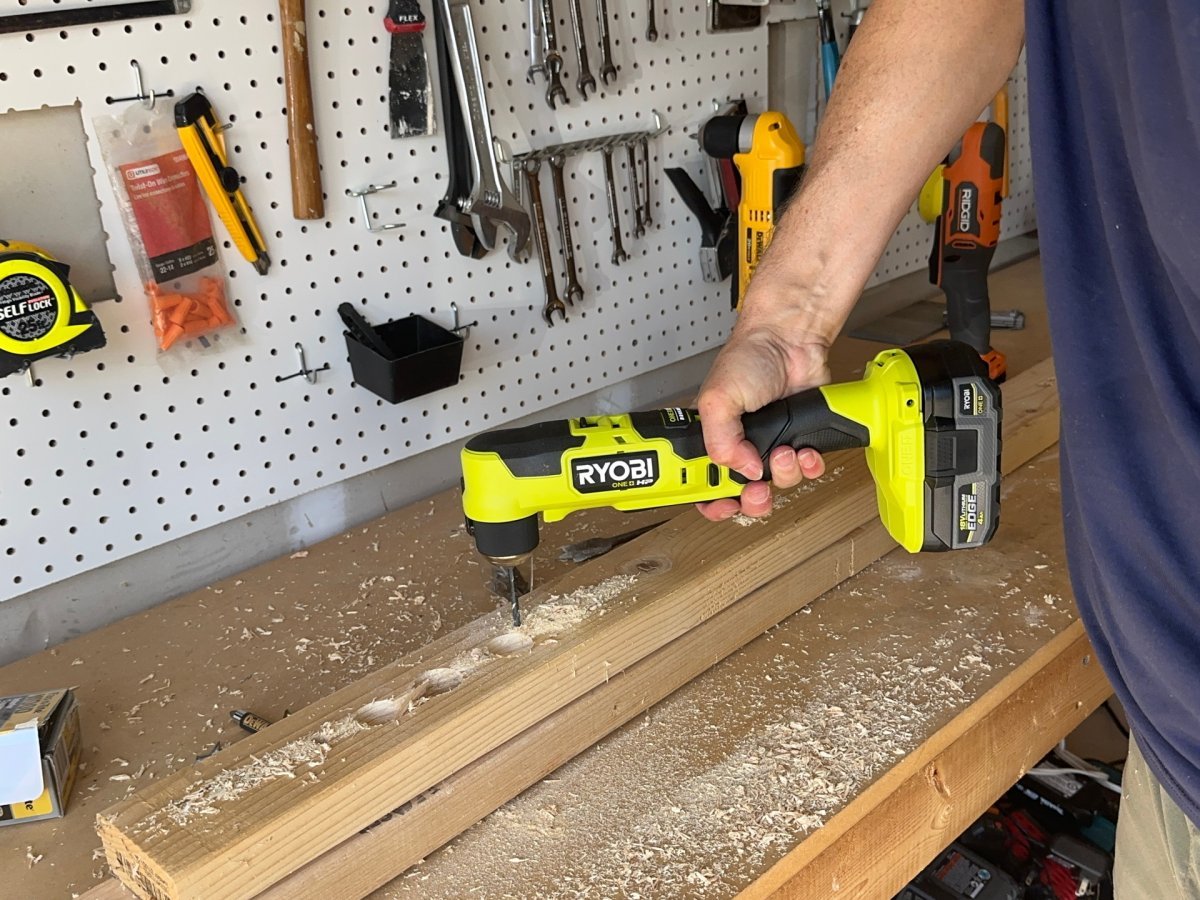
Before testing the tools in this lineup, we researched more than 20 of the most popular right-angle drills and right-angle drill attachments. Our testing involved a range of tasks commonly encountered by professionals and DIY enthusiasts alike. We tested the drills’ capabilities in drilling holes through various materials, including studs and joists, to simulate the challenges faced during electrical and plumbing work. We also assessed their effectiveness for driving screws in tight spaces, such as cabinet bases and other confined areas.
Throughout our testing, we paid close attention to the drills’ power, precision, and ease of use. We tested the drills with different types of bits—including standard, auger, hole-saw, and driver bits—to assess their versatility across various applications. We evaluated their power and performance to gauge their ability to handle different tasks efficiently. We also looked for ergonomic design and user-friendliness, considering factors like grip comfort and the convenience of features like LED lights and soft start-ups.
Finally, we awarded points based on a rubric: The better a tool performed a task, the more points it received. After testing, we averaged the points to help determine the best uses for the different tools.
Our Testing Scores
Product
Performance
Design
Value
<tr><td>
The width of the head is perhaps the most crucial feature of a right-angle drill because it determines the space into which it can fit. However, there are several other key factors to take into account, including motor speed, powerant attributes to think about when choosing the best right-angle drill
Corded vs. Cordless
Right-angle drills come in corded andcordless varieties, each with its own pros and cons. Cordless drills run on a rechargeable lithium-ion battery and offer the convenience and flexibility of not needing an electrical outlet or a cord. This lets you use them virtually anywhere.
Corded models, in comparison, require a standard electrical outlet. While these drills aren’t as convenient, a 120V power supply makes them more powerful while providing a reliable and constant power supply. Corded drills are also generally less expensive than cordless models. As with many power tools, spending more on a cordless model makes sense if it will see regular use. A less expensive corded model should suffice for DIYers who may use a right-angle drill only occasionally.
Size and Weight
Size and weight determine a right-angle drill’s functionality and ease of use. Because a right-angle drill is meant to fit into tight spaces, size is crucial. Most right-angle drills have a head between 3 and 4 inches wide, so they can reach places standard corded and cordless power drills can’t.
Right-angle drills can also be short and lightweight enough to manage with one hand—although heavy-duty models typically come with a secondary handle.
Chuck size is also important. Most right-angle drills have a ⅜-inch chuck, which helps keep the head compact. Some larger models feature a ½-inch chuck for drilling larger holes or driving in bigger screws. These models typically have a wider head.
Comfort and Grip
Right-angle drills have ergonomically shaped handles with rubberized grips that let you hold them securely with one hand while drilling. Many also have detachable side handles that let you apply more leverage with the other hand. Some manufacturers equip right-angle drills with paddle-style triggers that run the length of the handle. This feature lets you better regulate trigger pressure to control the drill’s speed.
Motor Speed
A drill’s speed determines how quickly the tool can drill holes or drive screws. It also gives an indication of how much torque the drill produces if the manufacturer does not provide that information. Speed is measured in RPM and, in most cases, is directly related to the power00 RPM, while some 20V drills can reach about 2,000 RPM
Corded right-angle drills have access to more power, which means they can produce more RPM. A corded 4-amp right-angle drill boasts around 2,400 RPM. While speed isn’t the same as torque, motors that can produce higher RPM are more powerful and thus capable of producing more torque.
Battery Life
When assessing a cordless tool’s battery life, consider not only how long each charge lasts but also how long the battery itself will hold a charge before it needs replacing. Most batteries for right-angle cordless drills will last about 3 hours on a single charge with intermittent use and will take about 3 hours to recharge.
Lithium-ion batteries typically last about 3 years, or about 300 to 500 charging cycles, before they begin to lose their ability to hold a charge. This doesn’t mean the battery will stop working altogether. As a battery nears the end of its life, it will simply last for a shorter period of time and require more frequent charging.
Attachments and Additional Features
As with standard drills, right-angle drills are capable of using various types of bits and attachments. These drills are adept at drilling holes with standard drill bits or driving in screws with Phillips-head, flat, star, and other styles of screw-driving bits. These drills can also use socket attachments to drive bolts.
Like other power tools, right-angle drills use a variety of accessories, including drill bits, screwdriver bits, chuck keys, and other accessories that can be misplaced. For this reason, many right-angle drills include a storage bag that holds the tool, accessories, batteries, and chargers all in one place for easy storage and transport.
Right-angle drills also often offer convenient features like LED lights that illuminate the work area and switches that make it easier to control the drill speed, permitting the user to increase or decrease the speed range to maximize control and improve torque.
For more information on how and where to best use a right-angle drill, read on for answers to some common questions about these power tools.
Q. How does a right-angle drill work?
A right-angle drill has a geared head that rotates the chuck 90 degrees from the body’s axis, letting it reach tight spaces and drill or drive at angles a conventional drill can’t.
Q. What do I use a right-angle drill for?
This versatile tool is helpful for a wide range of projects. It can be invaluable for fitting into tight spaces when working on a vehicle. A right-angle drill is also ideal for drilling between floor joists or wall studs, which are spaces that are typically too narrow for a standard drill.
Q. What is the difference between a ⅜- and ½-inch drill?
A ⅜-inch drill has a chuck that can accommodate drill bits up to ⅜ inch. Similarly, a ½-inch drill has a larger chuck that can handle drill bits with a maximum diameter of ½ inch. A ½-inch drill generally offers more power and torque, making it suitable for drilling larger holes and tackling tougher materials. It’s commonly used in construction and heavy-duty applications.
Q. What is a right-angle drill attachment?
A right-angle drill attachment is an accessory that can be added to a standard drill or driver to enable drilling and driving in tight or confined spaces that are difficult to access with a regular tool.
Q. Can a right-angle drill handle heavy-duty drilling?
Yes. A right-angle drill can handle drilling tasks that require high torque and speed, depending on the type of drill. A model drill such as the
